The other day, I read a post on Food Gal’s site that sent me straight to the kitchen. She mentioned how we can’t waste food these days, and so she found a couple of excellent uses for left-over ricotta. Wasting food is not just economically ill-advised, it’s an environmental misstep as well. I’m usually pretty anal about planning meals and using everything before it spoils, but once in a while I end up with a bit of something that has no defined purpose. As I hungrily looked at those lovely lemon ricotta muffins, I remembered that I too had some left-over ricotta in the refrigerator. When I started rummaging through the pantry, I found I was lacking lemon and almonds and the frugality of this endeavor would be a bit diminished by a trip to the grocery store. I could have just left them out, but Kurt was in need of a dessert item, a snack cake seemed like a good solution, and so I turned to another recipe which I found online.
Here’s the twist in this story: this is from a book that I don’t own. When Dolce Italiano appeared last year, I read mixed reviews and never acquired a copy. If anyone out there has this book, I’d love to hear what you think of it.
 This simple pound cake made good use of my remaining ricotta. It smelled so good when it came out of the oven, we couldn’t resist cutting into it before it had completely cooled. The crunchy, crusty edges were sweet enough as they were without a confectioner’s sugar dusting, and the interior was unbelievably tender. I may cook some apples or pears or cranberries to spoon over pieces of it tonight. The recipe states that the flavor is best the next day, so I can’t wait to find out if it’s even better than it was yesterday.

Last week, we received a bounty of greens from our CSA, and I was determined to find some new ways to prepare it. I like leafy vegetables and cook them often enough, but I wanted to branch out this time. It had been a while since I last used the book, Moosewood Restaurant Cooks at Home, and now that I’ve just thumbed through it again, I think I’ll be using it a lot in the near future. The aim of this book is to encourage whole-foods cooking in quick and easy ways. By limiting the number of ingredients, the "natural flavors of good basic foodstuffs" is highlighted. That concept works for me. In fact, most of the items presented in the book could easily become busy week night standard meals.
 For the gingered greens and tofu, I used broccoli greens and stems. The leaves of broccoli greens are a little thicker than other greens so they hold their shape well. They have a mild taste and worked perfectly here. The tofu was marinated for five minutes in a mixture of soy sauce, dry sherry, and rice vinegar. Then, it was broiled in the marinade until browned on each side. The greens were simply stir fried with ginger and vegetable oil and then hit with some chili oil, lime juice, and cilantro. For serving, the tofu and sauce were spooned atop the greens, and all was sprinkled with cilantro and chopped, toasted cashews. I also added some sliced hot chiles to the garnishes. It was just that easy.
 Kurt gets nervous when dinner includes the phrase stir fry because I usually botch it horribly. But, this time, all went well. In fact, he proclaimed this a success and would be happy with it in our regular meal rotation. I really liked it too. The chili oil and sliced fresh chiles gave it a good punch of spice, and the marinade became a delicious sauce for the dish. I’m glad I finally pulled that book off the shelf again.
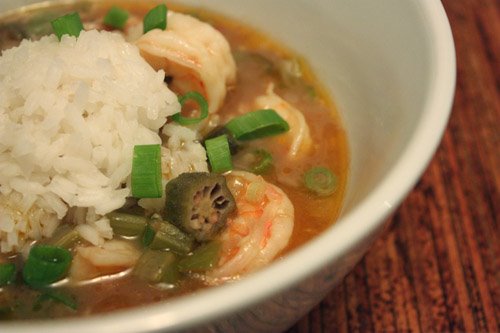
We started a new fall CSA subscription with Hands of the Earth farm last week. Our first pick up included lots of greens: tender, baby salad greens, small leaf braising greens, broccoli greens, and collards. Also, there were big, crunchy red radishes, serranos, green peppers, and red okra. Those last two items jumped up and shouted ‘make some gumbo.’
I need to explain how I came upon the recipe I used. In March, we attended a cooking class offered by Sara Roahen. We had some really outstanding food that night like oyster artichoke soup, stuffed mirliton, crab salad, and bread pudding with bourbon creme anglaise, and we learned a lot about preparing it all in classic New Orleans style. Her book, Gumbo Tales: Finding My Place at the New Orleans Table, is a collection of stories that highlight the city and the food and the people who cook it and love it. She wasn’t born in New Orleans, but she’s clearly come to regard the city and its surroundings with great affection. The stories mostly convey a pre-Katrina view but also note how things stood at the time of writing after the storm. Sadly, many of the restaurants she mentions had not re-opened when the book was published.
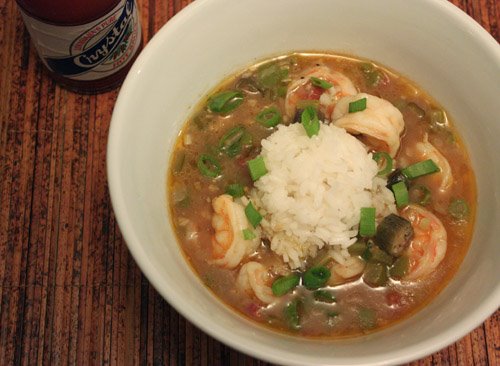 The first chapter is devoted to Gumbo in all its glorious, confusing, and infinite incarnations. Roahen describes how she came to understand gumbo by tasting several versions and forming a classification system of her own. One of her categories is Big Mama gumbo which she explains includes “everything but the kitchen sink.” In general, gumbos may be grouped by the thickener used in making them such as roux, okra, or file. Or, they may be categorized by the type of meat(s), type of sausage (if sausage is included), or type of fat used in making them. The only real constant in a gumbo is that it’s served with rice. There’s much more to be learned at southerngumbotrail.com.
I followed the recipe she provided at the class, and putting it all together is an event in itself. Visit Sara Roahen’s web site to read her blog, and you can ask her for this exact recipe if you’d like. We started by cleaning the shrimp and using the shells for stock the night before. The good news about shellfish stock is that it only simmers for 20 minutes. The next day, the vegetables were prepped and everything was put in place so my focus could remain on the roux. You do have to stir the roux continuously for at least 30 minutes. In truth, I got a little scared of it. I kept thinking, let it go a little darker, no wait, it could burn, stop it now. Stop thinking, keep stirring. The chopped green pepper, onion, celery, and garlic are added to the roux when it achieves the desired color. Then, that mixture is whisked into simmering shellfish stock. The cooked okra is added back to the pot with bay leaves, and it all simmers together for an hour and a half. Yes, it takes some time and patience to achieve a gumbo, but a lot of it is inactive, simmer time.
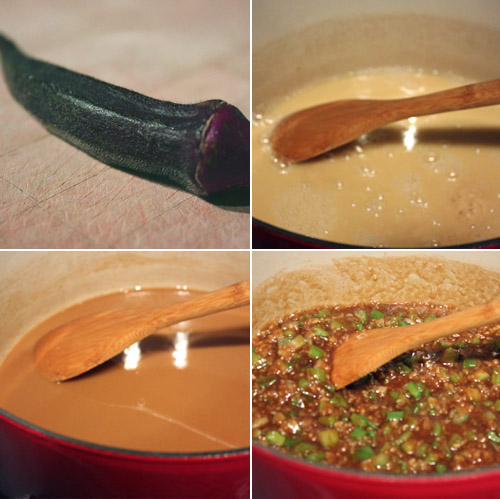 Roahen claims that something uncertain happens when gumbo ingredients spend that time together in the pot, and now I understand what she means. You already know what all those things taste like individually, but once they’ve formed a union, there’s some transformation that makes it into gumbo. The shrimp joins the simmering party just a few minutes before serving, and you should time the rice cooking by counting back from serving time.
Gumbo has a beautifully obscure look and transcendent taste of its own and a history that is equally complex. Now that I’ve got a first try under my belt, I’m ready to attempt other variations. I’ll be less timid with the roux color next time, and I’ll add even more cayenne at the end. Maybe I’ll try a duck version or add some file. The options are endless, and the flavor is always uniquely divine.