I hadn’t eaten a fish stick in years. As a kid, I always preferred fish sticks to burgers. In fact, that was about the only school cafeteria lunch item I ever ate, but I never touched the tartar sauce. I don't even know if kids still like fish sticks these days. At some point they disappeared from my diet. I assume that disappearance happened right about the time I was old enough to realize a re-heated, frozen, breaded piece of white fish left something to be desired in flavor, and I have no idea when it was I changed my mind about tartar sauce. So, when I saw this grown-up version of fish sticks with fresh halibut and a pickly, herby, homemade tartar sauce in the June Bon Appetit, I had to try it. I’m pretty sure this version could convince any adult to see fish sticks in a new light. The sticks were pan sauteed rather than deep fried, so there’s no heavy, greasiness about them, and the panko coating made them as crispy as can be.The tartar sauce came together with mayonnaise, chopped fresh dill, capers, chopped fresh chives, and finely chopped cornichons. Maybe I would have liked tartar sauce all along if it had always been made like this. For the fish sticks, fresh halibut was cut into short, narrow pieces and seasoned. Then, it was coated in egg and dredged in panko breadcrumbs. It cooked quickly in a nonstick skillet with just a tablespoon and a half of oil. It was a quick meal and a nostalgic one as well.Unlike the ones that came out of a box, these fish sticks were light, crunchy, and fresh-tasting. The tartar sauce was rich and tangy and addictive. I can’t remember what side dish the school cafeteria used to serve with their fish sticks, but it might have been tater tots. We enjoyed these with salad instead, and they surpassed any memory I had of fish sticks. I think they've found their way back into my diet for the foreseeable future.

 . I warned you I’d be using this book a lot. Now, about that swordfish. I admit I’m a worrier when it comes to buying fish. I always check in with the Monterey Bay Aquarium Seafood Watch list before making a purchase. The news changes from time to time, and I like to find out specifically which fish from which sources are the best options. As it happened, on the day I was planning to shop for swordfish, I learned about the Whole Foods MSC-Certified harpoon-caught swordfish program, and you can read about it here and here. There’s a short season for this type of sustainably caught swordfish, and I heard about it just in time. Also, on the topic of choosing fish responsibly, Chef Rick Moonen recently offered a list of five fish that deserve a break in the 5@5 post on Eatocracy. One of his recommendations was wild-caught swordfish.In Eating Local, the swordfish is grilled, but I was too lazy to cook outside in the heat and just seared ours on the stove. The peperonata was started by sauteing onion and garlic in a large skillet over low heat. Grated tomato was added and allowed to cook for five minutes. Then, sliced bell peppers, and in my case sliced jalapenos as well, were added with some red pepper flakes. The skillet was covered, and everything simmered gently for about 25 minutes. Capers and spoonful of white wine vinegar were added, and it was seasoned with salt and pepper. Some peperonata was scooped onto each piece of swordfish and topped with basil.
 Last weekend, I flipped through the A16
 book looking for something interesting and seasonal for a dinner meal. I decided on a braised fish dish and this warm roasted potato salad to go on the side. The fish was fine, we were happy with it, but it wasn’t something I was compelled to shout about from the rooftops. This potato and cauliflower dish, however, was very shout-worthy. Kurt and I agreed this was a big winner, and then we raced back to the kitchen for seconds.
Chunks of potatoes were tossed with olive oil and salt and then roasted in a 450 F oven. Throughout this book, it's common that seasoning will be with salt only if chile flakes are used later in the dish. The cauliflower was chopped into florets and tossed with a generous quarter cup of olive oil and some salt. It was then sauteed with that oil until the cauliflower just started to brown. Then, the saute pan went into the oven where the cauliflower roasted until browned but not limp. As the vegetables roasted, more olive oil was heated in a saucepan. Capers were fried in it, and then chile flakes were added with sliced red onion. When the onion had softened, the mixture was taken off the heat, and red wine vinegar was stirred into it. That mixture was the warm dressing which was then tossed with the roasted potatoes and cauliflower.
 It’s a simple combination of things that obviously go together well, but the olive oil and careful seasoning at each step and the warm caper, chile, onion, vinegar dressing all made it outstanding. As I said, this was the highlight of our meal served warm and crisp just from the oven. However, this could also be made in advance and served at room temperature. As a third option, if you’re lucky enough to have leftovers the next day, it’s also delicious as a cold salad taken right from the refrigerator and topped with tuna.

This is another quick and simple dish from Donna Hay’s Off the Shelf, and I served this chicken with spinach polenta with balsamic tomatoes. The photos and the straightforward nature of the recipes in this book make each and every thing in it difficult to resist. I looked through the Mediterranean chapter for ideas for what to serve with the polenta. Fish roasted in capers and lemon butter was one option. The balsamic and tomato roast chicken looked good but was too similar to the polenta dish. The tuna and grilled vegetable salad wasn’t quite right, but I’ll definitely be making that eventually. Likewise, the green olive baked chicken was almost perfect, but because cherry tomatoes were included in it, I finally settled on the gremolata seared chicken.
Gremolata was made by stirring together chopped flat-leaf parsley, chopped salt-packed capers that had been rinsed and drained, lemon zest, and black pepper. That mixture was sprinkled on chicken breasts, and the chicken was seared in olive oil in a saute pan. In the book, this chicken is shown being served with salt-roasted potatoes and steamed green beans. I’m sure that would have been delicious too, but the chicken also worked very well with polenta and roasted tomatoes.
 If I had been planning ahead, I might have applied the gremolata to the chicken and let it sit in the refrigerator for a few hours before cooking. And, certainly, the chicken could have been grilled or baked rather than pan seared. The gremolata provided a very easy way of adding a lot of flavor to the blank canvas that is chicken breast meat. Now, which page of the book should I cook from next?

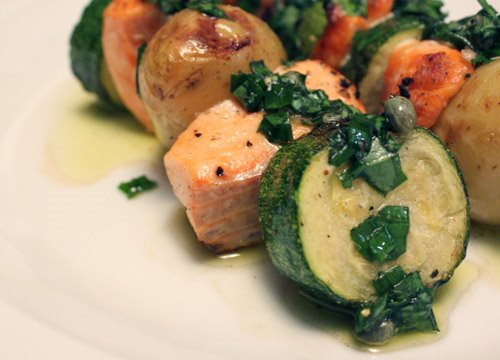
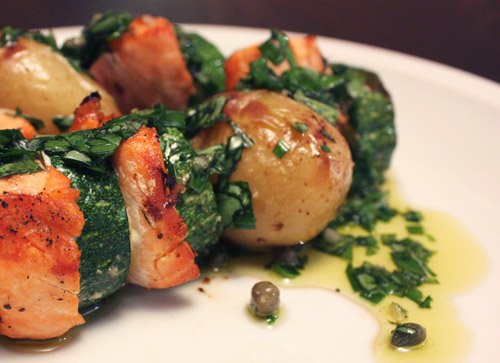
The other night, I really needed to think of something quick and simple to prepare for dinner. Luckily for me, I remembered The Fast 50 from the February/March issue of Donna Hay Magazine. That was 50 grilling recipes in a row that were simple, straightforward, and as usual for Donna Hay, looked amazing. The salsa verde salmon skewers were perfect for a main course, and I decided to add some vegetables to make each one a complete meal on a stick. The only thinking ahead that’s really required here is to get a thick cut of salmon so that it can be chopped into cubes that will work well on a skewer. I added chunks of zucchini and parboiled, small yukon gold potatoes.
The salmon and zucchini required the same amount of grilling time, and since the potatoes got a head start on the stove, everything achieved doneness at the same time. For the salsa verde, the recommended ingredients were a cup of mint, one third cup of flat-leaf parsley and one third cup of chives, a tablespoon of rinsed capers, a minced clove of garlic, and two tablespoons of olive oil. That sounded like a lot of mint to me, and since my basil plants have been growing so well, I decided to use a little mint and mostly basil. The herbs were chopped and combined with the other ingredients, and the finished salsa was drizzled over the grilled salmon, zucchini, and potatoes.
 It was a quick, fresh, flavorful meal lifted by the combination of herbs and the briny note of the capers. Such a simple sauce, but it brightened up and accented the grilled-in flavor nicely. This was another meal from Donna Hay that did not disappoint. And, there are 49 other quick, simple, grilled meals in that one article.