Saturday, September 3, 2011
Smoked Salmon Burgers
The recipe calls for one pound of fresh salmon and two and a half ounces of thinly sliced smoked salmon. The fresh salmon is cut into large chunks which are chilled before being pulsed in a food processor. The goal is to chop the big chunks but not to a smooth state. The smoked salmon was finely chopped by hand and then stirred into the chopped fresh salmon. Last, chopped fresh dill was added, and the patties were formed. It’s suggested that four patties be formed from the salmon mixture, but since I was dealing with some rather large buns, I divided the mixture into three portions for a better fit. After heating a little oil in a skillet, the burgers cooked for a scant two minutes per side. They just begin to brown, and the salmon barely cooks through. They were topped with mustard and arugula.
The mix of fresh and cured salmon gave these burgers a nice mix of flavors which the dill accented well. And, chopping the fresh salmon just enough but not too much is the key to great texture. For three simple ingredients, they combined perfectly for a very worthy burger.
Friday, February 11, 2011
Seaweed and Noodle Salad with Salmon Teriyaki
The noodle salad included both dried arame and wakame seaweed. If you’re not sure if you’ll like these, I recommend starting with arame and letting that be your gateway seaweed. It’s very mild in flavor and looks like skinny black pasta once rehydrated. Wakame is only slightly less mild, but it does taste a little more of the sea. Rehydrated, it looks like thawed, frozen, chopped spinach. Both were rehydrated in cool water and then drained. A dressing was made for the noodles with soy sauce, sake, mirin, rice vinegar, sugar, dashi, and sesame oil. I didn’t locate any dashi with no MSG, so I bought some bonito flakes and made a simple broth with a little boiling water. And, speaking of sake, I branched out in an attempt to learn more and tried an unfiltered option. The flavor was lightly floral compared to the last sake I used, and it seemed like a kinder, gentler sort of sake. Next, soba noodles were boiled, drained, rinsed, and drained again. The noodles were tossed with the dressing, the seaweeds, some sliced scallions, and I added some sliced orange bell pepper just because I had it on hand. The noodles can sit at room temperature, or they can be served cold. As they sat, I made the teriyaki sauce for the salmon from soy sauce, sake, mirin, and a pinch of sugar. The sauce was cooked in a pan just to dissolve the sugar while the fish was seared in a skillet. After searing the fish on both sides, the sauce was added and was used to baste the fish. The fish was removed so as not to overcook, and the sauce was left to thicken.
I served the noodles topped by the fish with the thickened teriyaki sauce poured over top. I knew this was going to be a good meal. For me, these flavors never disappoint. I made extra noodles, and the next day I enjoyed them cold from the refrigerator for lunch with chunks of tofu instead of salmon. Next time, I’ll probably add broccoli or greens. It’s great to learn this kind of adaptable dish that you can make a little differently each time you serve it.
Monday, July 5, 2010
Grilled Salmon a la Nicoise
First, the fish was seasoned with lemon zest and thyme and then grilled which was flavor-boost one. Next, the potatoes were roasted rather than boiled, boost number two. The cooked green beans and roasted potatoes were sauteed in olive oil with shallots and then tossed with spinach, olives, and lemon juice. Eggs were soft-boiled here which left them extremely tender and lovely. Last, the tomatoes were warmed and softened with melted butter and minced anchovy. The buttery tomatoes became a sauce that was spooned over the grilled fish which sat on top of the spinach salad, and it was crowned with sliced green and opal basil.
Nicoise salad has always been a favorite meal kind of salad of mine, but this one was a cut above the usual. The roasted potatoes with bits of surface crunch and the added shallot, olive oil flavor and the sweet, salty bite of bursting tomatoes in warm anchovy butter elevated this version. And, the soft-boiled eggs were rich and a little delicate and just seemed special. Yes, this was a very good way to make a Nicoise salad.
Friday, May 21, 2010
Seared Salmon on Coconut Spinach
Wild salmon was marinated with grated ginger, sesame oil, and soy sauce, and then it was briefly seared on each side. Meanwhile, I cleaned some spinach I received from my CSA. Garlic, chopped red chiles, and chlli paste were cooked in a saucepan with a little oil. Coconut milk and lemon juice were added and simmered. Then, in went the spinach which cooked until it wilted. The end. Dinner was ready. This was possibly the fastest meal I’ve made in months.
I accept that being on vacation, being away from home, being in a place for the sole purpose of having fun does indeed make food taste great, and that’s why I remember that meal so fondly. It’s also true that some ingredients just go together really well, and salmon, spinach, and ginger fit that description. This version with coconut milk and red chiles built on that theme. I enjoyed it as much as I thought I might, and I like that it wasn’t an exact re-creation. Instead, it became that great salmon and spinach meal I made at home that reminded me of that vacation.
Monday, September 28, 2009
MangO Salmon Salad
I wasn’t kidding about how simple this is, and there really isn’t much to the recipe. You simply place some salmon fillets in a glass dish and pour mango juice over them. Let the salmon sit in the mango juice for 20 minutes while you pre-heat the oven to 450 degrees F. Then, heat a tablespoon of olive oil in a non-stick skillet over medium-high heat, remove the salmon from the mango bath and dry each piece, and place the salmon flesh-side down in the skillet. Turn the heat down to medium and sear the salmon for five minutes. Carefully turn the fillets and place the skillet in the hot oven for about three minutes. Pour the mango juice from the glass dish into a saucepan and bring to a boil. Let the juice simmer for a few minutes to thicken slightly. Remove the skillet from the oven and pour the simmered juice over the salmon. Chopped garlic chives garnished the salmon, and since my garlic chive plants have flowers right now, I garnished with those as well.
For the salad, I made a lime shallot vinaigrette which was tossed with mixed baby lettuces. That formed a bed on each plate. While grocery shopping, I looked for something to sit in the center of the salad and found some delicate, little arugula micro greens that were locally grown at Bella Verdi Farms. Those were also tossed with some of the vinaigrette and were then placed in the center of the salad. Pieces of mango sauce-covered salmon were placed around the mound of micro greens. For contrast, flavor, and crunch, I sprinkled on thinly sliced red fresno chiles and green onions and some chopped cashews.
CONTEST RULES
O Foods Contest for Ovarian Cancer Awareness Month
September is Ovarian Cancer Awareness Month, and for the second year in a row, Sara of Ms Adventures in Italy and Michelle of Bleeding Espresso are hosting the O Foods Contest to raise awareness of this important health issue.
There are TWO WAYS to take part in the O Foods Contest:
ONE: Post a recipe to your blog using a food that starts or ends with the letter O (e.g., oatmeal, orange, okra, octopus, olive, onion, potato, tomato); include this entire text box in the post; and send your post url along with a photo (100 x 100) to ofoods[at]gmail[dot]com by 11:59 pm (Italy time) on Monday, September 28, 2009.
PRIZES for recipe posts:
- 1st: Signed copy of Dolce Italiano: Desserts from the Babbo Kitchen by Gina DePalma, Executive Pastry Chef of Babbo Ristorante in NYC, who is currently battling ovarian cancer, inspired this event, and will be choosing her favorite recipe for this prize;
- 2nd: Signed copy of Molto Italiano: 327 Simple Italian Recipes to Cook at Home by Mario Batali (winner chosen by Sara);
- 3rd: Signed copy of Vino Italiano: The Regional Italian Wines of Italy by Joseph Bastianich (winner chosen by Michelle)
ORTWO: If you’re not into the recipe thing, simply post this entire text box in a post on your blog to help spread the word and send your post url to ofoods[at]gmail[dot]com by 11:59 pm (Italy time) on Monday, September 28, 2009.
Awareness posts PRIZE:
One winner chosen at random will receive a Teal Toes tote bag filled with ovarian cancer awareness goodies that you can spread around amongst your friends and family.From the Ovarian Cancer Research Fund:
- Ovarian cancer is the leading cause of death from gynecologic cancers in the United States and is the fifth leading cause of cancer death among U.S. women; a woman’s lifetime risk of ovarian cancer is 1 in 67.
- The symptoms of ovarian cancer are often vague and subtle, making it difficult to diagnose, but include bloating, pelvic and/or abdominal pain, difficulty eating or feeling full quickly; and urinary symptoms (urgency or frequency).
- There is no effective screening test for ovarian cancer but there are tests which can detect ovarian cancer when patients are at high risk or have early symptoms.
- In spite of this, patients are usually diagnosed in advanced stages and only 45% survive longer than five years. Only 19% of cases are caught before the cancer has spread beyond the ovary to the pelvic region.
- When ovarian cancer is detected and treated early on, the five-year survival rate is greater than 92%.
And remember, you can also always donate to the Ovarian Cancer Research Fund at our page through FirstGiving!
Please help spread the word about ovarian cancer.
Together we can make enough noise to kill this silent killer.
Tuesday, September 8, 2009
Big City Salmon with Martini Sauce
The salmon could have been grilled, roasted, or even poached, but I did my usual quick sear in a saute pan, turn, and place in a 400 F degree oven for a few minute to cook not quite all the way through. The sauce was started by reducing gin and vermouth with chopped shallots and juniper berries. Once reduced to about three tablespoons, cream was added, and that was reduced again. It was then strained into a bowl and poured back into a saucepan so just a little butter could be incorporated. Sliced pimento-stuffed olives and lemon juice were added. Meanwhile, the slaw was very quickly assembled. I thinly sliced the zucchini and fennel with a Benriner, and they were dressed with a combination of mayonnaise, lemon juice, chives, and mustard.
The meal worked out great. The martini sauce was nicely flavored in a pleasantly boozy sort of way, and the juniper berries gave it a very subtle, wispy hint of pine. The olives took charge visually and brought little punches of brininess that went well with the salmon. And, even though the slaw just sat in the background, off to the side of the plate, it was more delicious than I expected. It was shown in Gourmet with salmon cakes, it was great with the salmon I made, and I can imagine it as a side with all sorts of other things too. It’s incredibly simple to prepare, and I definitely recommend it.
Sunday, May 24, 2009
Salsa Verde Salmon
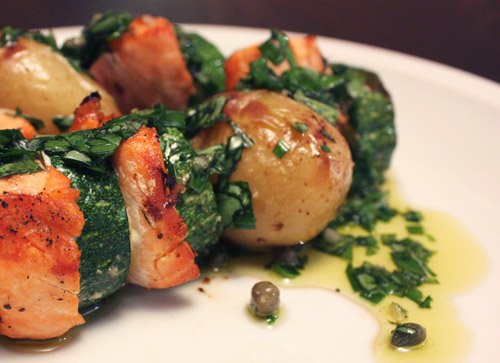
The salmon and zucchini required the same amount of grilling time, and since the potatoes got a head start on the stove, everything achieved doneness at the same time. For the salsa verde, the recommended ingredients were a cup of mint, one third cup of flat-leaf parsley and one third cup of chives, a tablespoon of rinsed capers, a minced clove of garlic, and two tablespoons of olive oil. That sounded like a lot of mint to me, and since my basil plants have been growing so well, I decided to use a little mint and mostly basil. The herbs were chopped and combined with the other ingredients, and the finished salsa was drizzled over the grilled salmon, zucchini, and potatoes.
It was a quick, fresh, flavorful meal lifted by the combination of herbs and the briny note of the capers. Such a simple sauce, but it brightened up and accented the grilled-in flavor nicely. This was another meal from Donna Hay that did not disappoint. And, there are 49 other quick, simple, grilled meals in that one article.
Thursday, April 16, 2009
Grilled Salmon Sandwiches with Pineapple-Mustard Glaze and Green Chile-Pickle Relish
This time, the mixture that was to have seasoned the tuna was used as a marinade for salmon. Dijon, chipotle puree, honey, oil, and green onions were combined with salt and pepper, and I spread that over the salmon and left it to rest in the refrigerator for 30 minutes. I made the glaze the same as before by combining pineapple juice, white wine vinegar, grated ginger, and soy sauce in a pan. This was brought to a boil and reduced to half its volume which took about 30 minutes. There was supposed to be some brown sugar in that mixture, but the pineapple juice was sweet enough for me, and I omitted it. For the relish, poblano chiles were roasted, peeled, seeded, and diced. They were combined with diced dill pickle, finely chopped red onion, lime juice, chopped cilantro, and olive oil. Honey should have been added, but there I go again not liking things too sweet. So, the honeyless relish was seasoned with salt and pepper and was ready to go.
The marinated salmon was grilled and glazed twice with the reduced pineapple elixir. The side dish for this meal was seasoned grilled fries, and they couldn’t be simpler. Potatoes were cooked on the stove until almost tender, then chopped into wedges, basted with oil mixed with ancho chile powder and salt, and then grilled. The best part is that they don’t stick to the grill. The potato surface instantly crisps and they finish cooking through quickly while acquiring that irresistible grill flavor. I served the marinated, grilled, pineapple glazed salmon topped with the green chile-pickle relish on toasted sesame-semolina sandwich rolls. Have you ever noticed how long the names of Bobby Flay dishes are? Long names, lots of components, bold flavors, but delicious food. This is a completely opposite food philosophy from that of allowing simple, fresh flavors to shine individually, but it has its place on my table. It’s a fun combination of spicy, sweet, sour, tangy, smoky, fresh, and I recommend it.
Monday, February 16, 2009
Eggplant Salmon
Salmon fillets were cut down the center so as to accommodate a stuffing of eggplant and fresh mozzarella. The Japanese eggplant was first thinly sliced and sauteed with garlic and just a touch of soy sauce. Once cooled, it was tossed with cubed mozzarella and chopped garlic chives. The salmon was filled and then baked until the stuffing had heated through. The components of this were so simple to prepare but so delicious together. The sauce was just as easy. Chopped onion was cooked with chopped tomato. I know what you’re thinking. With eggplant and tomato, this sounds like a summer dish. Fair enough, but we do get pretty good locally, organically, greenhouse-grown tomatoes here, and since it was cooked with the onion for 15 minutes, it worked out fine. For this sauce, canned whole tomatoes would work too. The sauce was supposed to have received some basil after being pureed and strained, but I used a combination of homegrown parsley, thyme, and oregano instead. The tomato sauce was pooled onto the plate and topped with the salmon.
It all worked incredibly well together, but we also soon realized the stuffing would make an excellent vegetarian dish on its own. After filling the salmon, there was extra stuffing which I baked in a small dish. That alone would be lovely served with the tomato sauce. The sauce delivered brightness and incredible flavor considering the very short ingredient list. With the mozzarella melted into the buttery salmon, the tender eggplant made flavorful with garlic and soy sauce, and the smooth tomato sauce, this was a great finale to a seafood day.
Monday, January 12, 2009
Light Tex-Mex
I realize the sauce looks mole-like, and I just prepared a mole a couple of weeks ago, but it’s different, it really is. First, this is much less involved. Onion, garlic, tomatillos, anchos, guajillos, and serranos are sautéed together with some broth and lemon juice. Once the dried chiles are somewhat reconstituted, all is pureed with cilantro and strained. The sauce is then re-heated in olive oil and seasoned to taste. I usually skip straining, but I’m glad I did it here. The sauce became velvety smooth, and the last re-heating with oil step made it even more so. The complex spice and sweetness and the layers of mole flavor are not part of this sauce. Instead, this sauce is more of a punch of piquant chile heat, rounded earthy chile flavor, with slight tangy undertones. The resulting dish was all about the sauce with the roasted coho salmon serving merely as a delivery system for it. A lighter fish would have disappeared all together, but the salmon performed adequately.
The spicy sauce required a quiet, calming companion like rice, and the Mexican mint marigold variation was lovely here. Mex. mint marigold, tagetes lucida, is an herb that grows easily here in Texas with an anise scent and flavor. Tarragon doesn’t fare so well in our heat and humidity, so it makes a very good substitution. It’s a low-maintenance, compact, perennial and produces little, yellow flowers in the fall. Its slender leaves are easily pulled from its stems, and a tablespoon of chopped leaves were added to the finished rice. First, onion, garlic, and chopped serrano were sautéed with the rice before water and butter were added. That adds a lot of flavor and a near nuttiness, and sautéing the rice in oil prevents the grains from sticking together once cooked. Tossing in the chopped herb added a subtle bit of freshness and barely there anise.In the end, I got what just I wanted: big flavor, some serious spicy heat, an interesting rice dish, and cool, refreshing, crunchy slaw, all in a light meal.

Tuesday, November 11, 2008
Seared Salmon with Tatsoi and Persimmons
In my head, I pictured the salmon fillet resting atop a thick sauce with a light and leafy composition on top with a garnish of persimmon slices. So, I thought back to a recent experience with broccoli rabe pesto, and decided to try a tatsoi, pecan pesto minus the cheese. To start, I blanched about four cups of the tatsoi leaves by placing them in a sieve, lowering the sieve into boiling water for one minute, and then moving it immediately into a bowl of ice water. The leaves were then squeezed to remove as much water as possible. Blanched leaves were placed in the blender with about a half cup of pecans, a tablespoon of lemon juice, and half a cup of olive oil. This was pureed and seasoned with salt and pepper. I left the bowl near the stove for it to keep warm while the salmon was prepared.
Wild Coho salmon fillets were seasoned and quickly cooked on the stovetop. I made a lemon and rice vinegar vinaigrette with shallots and dijon, and tossed a handful or two of fresh tatsoi leaves in it. I also cut some daikon into matchsticks and tossed them in the vinaigrette with the tatsoi. The tatsoi puree was pooled onto the center of the plate and received the salmon. The leaf and daikon combination was set onto the salmon, and then, persimmon slices found their place.This was one of the quickest meals I’ve prepared lately. I kept looking around the kitchen thinking I’d forgotten something. It was a somewhat light and very nice meal. The vinaigrette and the oil in the puree added just enough richness to the greens. The blanched, pureed greens had less pepperiness than the fresh leaves which made for a good balance. And, the persimmons brightened up the plate literally and figuratively. Their flavor was outstanding with the salmon, and all the components together behaved exactly as I’d hoped. The daikon added nice crunch but wasn’t entirely necessary. If I were to make this again and couldn’t get tatsoi, arugula would work very well.

Tuesday, May 27, 2008
Lime-Habanero Mayonnaise with Grilled Salmon and Micro Greens
This dish was inspired by a Bobby Flay recipe, but I made a few changes. Bobby’s dish was tuna salad made with the mayonnaise and put into a sandwich with watercress. He suggested a lemon-habanero mayonnaise, but I’ve moved on from lemon for now so I used lime. Also, I used less lime juice and less onion than suggested, and I added garlic. I used the mayonnaise as a sauce over grilled salmon, and since I couldn’t find watercress, arugula micro greens dressed in a lime vinaigrette danced on top. As a sauce, it’s a little acidic, so next time I might cut back on the reduced lime juice, but if it were put into a sandwich or on a fish taco, it would be fine. Actually, on a fish taco it would be amazing. The mayonnaise gets even better after sitting in the refrigerator overnight. It was divine on a veggie burger the next day. Grilled chicken would also be a good vehicle, and I might try that tomorrow. When making the mayonnaise, I would recommend adding just a little habanero at first, tasting, and adding more if you want it hotter. I ended up using one and a half habaneros this time as they were kind of small. Here's my rendition of the mayonnaise:2 c fresh lime juice
1 to 1 1/2 habanero chiles, seeded and chopped
1 t lime zest
1 c excellent, prepared mayonnaise (or, make it fresh)
2 T red onion, finely diced
½ large stalk celery with leaves, finely diced
2 cloves garlic, chopped
2 T fresh flat-leaf parsley, chopped
Salt and pepper to taste
-Place lime juice in a small saucepan and bring to a boil. Cook until reduced to 1/3 c. Remove from heat and let cool slightly. Place lime syrup, habanero (a little at first), and remaining ingredients in blender and blend until smooth. Add more habanero to taste.


