and was a bit dismayed with what he had to say about sourdough bread. He wrote: "Despite my own feeling that sourdough bread is much overrated and is difficult to perfect at home I am including one recipe in this collection because interest in the subject is so tremendous... I'm not sure it is worth the trouble." Difficult? Not worth the trouble? I wish I could have had the opportunity to convince him otherwise. Yes, making bread from a sourdough starter requires time and patience, and yes, the results vary depending on the strength of the starter, the weather, and the flour used, but it also seems a little like magic to make bread with such simple ingredients and a home-grown, living, wild yeast starter. With bread-baking, time means flavor, and nothing compares to the taste of slowly fermented and proofed sourdough. I could go on all day about my love of sourdough bread baking, and it's interesting to note that the one sourdough recipe Beard included in this book was made with a starter created from commercial yeast rather than being grown from wild yeast. But, the book is full of several interesting breads of other types. The pizza caccia nanza with pieces of sliced garlic and rosemary inserted in the dough before baking sounds delicious. Jane Grigson's walnut bread from southern Burgundy with onions, walnuts, and walnut oil is one I plan to try too. There are also quick breads, rolls, pita, doughnuts, biscuits, and monkey bread to name a few. So, there are many great things about this book even if Beard was completely wrong about sourdough.One of those great things was the recipe for a rich cornbread. This was one of Beard's oldest bread recipes and one of his favorites. Not only is this cornbread filled with fresh corn kernels and chopped green chiles, there's grated cheese and a full cup of sour cream. Canned, chopped green chiles are suggested, but since I like to roast chiles, I made my own. I roasted two poblanos on top of the stove and then peeled, seeded, and chopped them. Then, kernels were cut from three ears of fresh corn, and a quarter pound of gruyere was grated. Making the bread couldn't be simpler since you just stir together yellow cornmeal, salt, baking powder, that full cup of sour cream, three quarters of a cup of melted butter, two eggs, the grated cheese, and chopped chiles. The mixture was baked in a nine inch square pan, and it browned nicely on top.

 . It’s a rich dough that forms well and is easily worked. The lasagnettes recipe is also found in that book.The dough was rolled into long lasagna sheets which were cut down to about twelve-inch pieces for cooking. The cut sheets were boiled for about three minutes, transferred to ice water to stop the cooking, and then they were cut into three-inch rounds. I stored the scraps of pasta in a bag in the freezer for some future use in which the shape won’t matter. The cut pasta rounds were covered with a damp towel and refrigerated until the other parts of the dish were ready.


 the other day. Since this is a book about family meals, it’s organized according to how planning meals at home supposedly happens. The chapters for main courses of meat and fish come first assuming those are chosen first, and they're followed by soups, salads, vegetables and side dishes, breads, and desserts which are picked to go with a main course. That makes sense. Although, I have been known to plan meals around a vegetable or salad I have in mind. This particular meal did involve barbecued chicken, but my real plan was to put together a menu that would include fresh, local corn. The creamed corn recipe in the book had stuck in my head, and I had to have it. Creamed corn may not ordinarily require a recipe, but in this case, it led me to adding cayenne and lime zest, and so I was happy to follow it. Then, the asparagus coins caught my eye. Rather than leaving the asparagus in spears, they were cut into nice, little rounds and cooked with chive oil and parsley water. Yes, it was just a tad fussy for a simple, home-cooked side dish, but the flavor was fantastic.


I kind of like ingredient-hunting through recipes. It’s become a fun, new hobby of mine when I have an ingredient and can’t decide how to use it. I start looking through the indexes of cookbooks, searching for whatever the ingredient of the day is, in hopes of finding some interesting dish in which it’s used. When I decided to make Thai style crab cakes the other day, I used some Thai basil from the farmers’ market. After making the crab cakes, there was still a lot remaining of the very generous bunch I had received. So, off on my ingredient-hunt I went. My first stop was the index of Local Flavors , and under Thai Basil, it reads 'see basil.' And, under basil, I found this dish, and the hunt was over in record time. In creating this dish, Deborah Madison was inspired by the flavor of Thai basil, rather than Italian basil, with corn and zucchini, and then decided to add coconut milk and tofu. I think that she had a fantastic idea.
Cubed tofu was dried and then browned in a skillet with zucchini chunks. Fresh corn was cut from four ears, and the corn milk was pressed from the cobs with the back of a knife. All of that was added to the skillet along with chopped green onions, some Thai chiles, and chopped cilantro and Thai basil leaves. Coconut milk was added, and it simmered for just a few minutes, and dinner was ready. This simple stew was served with white, long-grain rice.
 Everything about the dish was very fresh-tasting, and even though it was all about the Thai basil for me, I wouldn’t skip this if you don’t have any on hand. You could go with all cilantro or even try it with Italian basil. Corn, zucchini, tofu, and coconut milk are all a little mild in the flavor department, but they go together very well. In fact, there was something very comfort food-like about that combination. It’s the green onion, chiles, and herbs that livened things up and gave the dish great character. All together, it was a dish that seemed like an old friend even though this was the first time we’d experienced it.


For lack of an original idea, I can tell you this dish represents two great tastes that taste great together. It’s not candy, but the principle applies. The tomatoes on their own are full of flavor after baking with balsamic vinegar, olive oil, and fresh oregano. The polenta is balanced with parmigiano reggiano richness and the fresh taste of spinach. Each component is noteworthy on its own, but put them together and what you get is a step above that. I wanted to try this as soon as I first read Donna Hay’s Off the Shelf earlier in the year. At the time, it wasn’t tomato season yet, so I waited. When the season got here, I of course, had completely forgotten about the dish. Luckily, I flipped through the book again last week and was reminded of it just in time.
It’s quick to prepare because the polenta is cooked while the tomatoes are in the oven. The tomatoes were halved and placed in a baking dish. Then, balsamic vinegar, olive oil, fresh oregano leaves, and a pinch of sugar in my case, since I reduced the amount, were combined and poured over the tomatoes. This was baked for 20 minutes at 400 F. Meanwhile, milk and water were brought to a boil, polenta was slowly whisked in and then stirred until cooked, shredded parmigiano reggiano and fresh spinach were incorporated, and I added some kernels of fresh corn as well.
 The polenta was served with tomato halves on top, pan juices from the tomatoes were spooned over it, and it was finished with a little extra shredded parmigiano. I tasted the two parts of the dish separately and thought both were great. Then, I tasted them together and realized what a great combination this was intended to be. So go ahead and put some balsamic roasted tomato in your spinach polenta, and you’ll see what I mean.


For our Austin food blogger hatch chile potluck, I made a sourdough bread with roasted hatch chiles and roasted garlic in it. Luckily, the bread turned out fine, but since it was an experiment and I wouldn’t know if it seemed ok or not until the last minute, I also had a back-up plan. The back-up plan unraveled something like this: remember that asparagus lasagna I made back in March with the cream and parmigiano sauce? Yes, what if I made that with roasted hatch chiles and fresh corn instead of asparagus and then used Mexican cheeses instead of Italian ones? It sounded like an interesting flavor combination, but do you also remember what that lasagna looked like and can you imagine how it would look after being transported to a potluck and sitting out for a while? Right, so I started thinking of ways to combine those ingredients in another format, and that’s when I found the risotto balls recipe in Martha Stewart's Hors d'Oeuvres Handbook. Fried arancini would travel much better than a lasagna with cream sauce.
I made the risotto as suggested in the book, but at the end I added about seven hatch chiles that had been roasted, peeled of the charred outer layer, seeded, and chopped. I also added fresh corn kernels cut from two small ears of corn, and a couple tablespoons of chopped cilantro. Then, instead of using grated parmigiano, I grated a dry jack cheese and stirred it into the risotto. The finished risotto was left to cool and was then refrigerated overnight. There are a few steps to completing this hors d’oeuvre, but each of them can be spaced out and tackled when you’re ready. Once the risotto had completely chilled in the refrigerator, it was ready for forming into balls. For each, one tablespoon of risotto was formed into a cup shape into which a small cube of queso oaxaca was placed. Then, the risotto was gathered around the cheese cube and rolled into a ball. Once all the balls were formed and placed on a parchment-lined baking sheet, they were refrigerated overnight. Next, the risotto balls were breaded with flour, then egg, then cornmeal. At that point, they could have been refrigerated again until ready for frying. They were briefly fried for two minutes or so in a saucepan with a few inches of hot oil.
 The cornmeal made a nice crunchy surface which contrasted well with the oozing center. Sweet, fresh corn and smoky, roasted hatch chiles sidled up comfortably to the queso oaxaca. The flavor combination here was a good one, and I think the lasagna version will be just as good when I can serve it at home straight from the oven.

I just returned from the Wednesday Farmers’ Market where I pick up our CSA share every other week, so I’m in the right frame of mind to tell you a little about Local Flavors by Deborah Madison. For this book, she visited farmers’ markets all across the US, including Hawaii, to see the differences from place to place. The chapters are, for the most part, organized by season starting with early spring and proceeding through fall. So, the first chapter’s recipes highlight what you’re likely to find at markets at the beginning of the year. There are stories strewn about that tell of Madison’s visits to various markets and the farmers she met. She offers suggestions for substitutions for regional things that might not be found in all areas of the country or that become available at different times. The real goal of the book is to encourage support of local farmers, to explain the value of fresh, local food, and to inspire the home cook to make good and delicious use of locally grown food. As luck would have it, Russ Parsons of the LA Times wrote about cooking with farmers’ market produce today too. He wrote about improvising with what you find and suggested "Cooking from the farmers’ market is a bit like playing jazz."
Last week, I mentioned having a lot of greens on hand, and when I saw this recipe in the book I knew it would be a great way to use some of them. It’s listed in the book as redbor kale with red beans, cilantro, and feta cheese. I had spinach and what I think was broccoli greens, and any kind of greens would be good here. One of the interesting points that Madison makes in the book is that by buying at farmers’ markets, you have the chance to get the same vegetables at multiple stages. When a planting needs to be thinned, the greens may be cut and sold earlier in the season. When the vegetable is growing, you may be able to buy small versions of it, and then you’ll later see the mature state for sale. I’m not sure if the greens were offered because of thinning or not, but it’s interesting to think about the growing season and being involved in it in some small way. So, I had planned this for dinner the other night, and while out picking up the feta, I found some Texas-grown corn. I love fresh corn. I had an inkling that it might be a nice addition to this dish, and adding another locally grown item definitely seemed to be in the spirit of the book.
 I cheated a little and used canned beans, so I skipped the part of the recipe about cooking red beans. I also skipped the part about boiling the greens because I find it so much simpler, and more flavorful, to saute them. So, I cleaned and chopped the greens, sauteed them with finely chopped onion and the last of my homegrown cilantro, and then I added some water and the rinsed and drained canned beans. I cut kernels from two ears of fresh corn and added that as well. This was left to simmer for about 10 minutes, and then I served it with brown rice and a nicely pungent sheep’s feta crumbled on top. I like greens with beans, and the cilantro added nice flavor. But, and I really don’t mean to pat myself on the back here because I’d rather pat the person’s back who grew the corn, that fresh corn made the dish. I highly recommend seeking out the freshest, local corn and greens you can find when they’re available and giving this a try.
If you’re curious about what’s available at the Austin Farmers’ Market at this time of year, today my CSA pick up included: zucchini big and small, baby yellow summer squash, onions, red beets with gorgeous greens, baby leeks, orange carrots with leafy tops, watermelon radishes, tiny, baby green cabbages, and a red cabbage. Also at the market, there were some first of season tomatoes, and a some tomatoes that had been greenhouse grown, cucumbers, green beans, some other summer squashes, arugula, and potatoes. Other vendors offer locally made cheeses, grass-fed beef, bison, lamb, chicken, and eggs, and I know I’m probably forgetting several other things like the delicious-looking bread. For dinner tonight, I’m going to blanch some of those perfect green beans and then toss them in a leek vinaigrette with chopped cucumber and tomato. That’s getting topped with leftover sheep’s feta.

This is the slaw that inspired the light tex-mex meal. I knew it was in Nuevo Tex-Mex which got me flipping through the book again and meal planning. I often say of some cookbooks that I want to make everything in them, and I mean it when I say that. It may take some time given how many books are in that group, but this book is one of them. And, now for a confession. I always post about dishes that I’ve just made for the first time, or new variations on dishes, or seasonal versions of recipes that I want to remember. However, I have made this slaw before. But, I didn’t make it right the first time. It was years ago, I was rushed, and I glanced at the ingredients and didn’t read all of the instructions. This time, I read more carefully and prepared it as it was intended. That first time, I made a mostly raw slaw with bell peppers, jalapeños, cabbage, onion, and cooked corn. I missed the roasting step which, it turns out, makes a completely different and entirely better slaw.
Because it’s January and fresh sweet corn is not available, I used frozen corn kernels which were ok. If making this with fresh corn, you should roast it on the cob and then cut off the kernels. With frozen corn, I defrosted it, tossed it with a small bit of oil, spread it on a baking sheet, and roasted it in the oven until fragrant and slightly browned. Its flavor became concentrated, it became even sweeter, and it was fantastic. The bell peppers should also be roasted, then skinned, seeded, and chopped. I seem to remember Bobby Flay mentioning on thousands of occasions that peppers should always be roasted in the oven instead of over a gas flame. Oven roasting actually cooks the pepper flesh instead of just charring the skin and results in better flavor, and that’s what I did here. He’s right about oven roasting, but I also do the quick and easy turning over a gas flame when short on time. So many confessions today.
 The slaw, then, was crunchy raw cabbage, jalapeño, and onion, sweet and concentrated roasted corn, oven roasted red and orange bell pepper, and lemon juice, champagne vinegar, and chopped cilantro. The combined ingredients sat in the refrigerator for a couple of hours, and came out bursting with varied flavors, colors, and textures. You can control the heat of the jalapeños by removing the seeds and membranes which I did because the sauce served with this meal was already hitting the upper level of our heat tolerance. That left the slaw as a welcome, cool, acidic, sweet, savory, fresh part of the light tex-mex meal.

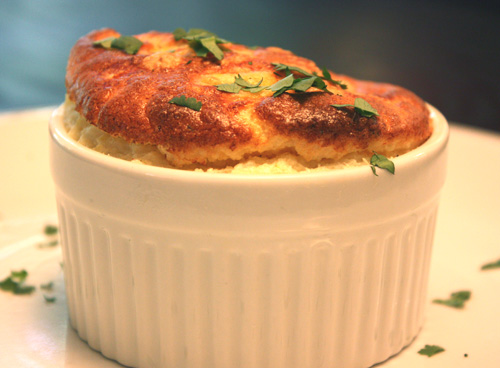
 Last weekend, I tried a few new and different dishes, and all of them had one thing in common. Everything I prepared was incredibly simple and shockingly good given the scant active time involved. Souffles, so dramatic in appearance but simple to create, clearly fit this description. This recipe from Bon Appetit’s June issue was the main dish of our Sunday brunch.
  After making corn cream and macque choux the night before, I had some remaining fresh corn. It just seemed like a perfect fit to include it in the grits soufflés. And, it was. The airy egg texture was contrasted by a fresh burst of corn. I didn’t have any leeks, but the 3/4 c yellow onion plus green onions provided enough flavor from the allium family. The pepper Monterey Jack was a nice addition, and more heat from fresh jalapenos would be a consideration in the future. I garnished the finished soufflés with chopped cilantro.
 When dishes require a lot of chopping, marinating, blanching, basting, waiting, mixing, turning, slicing, etc., you feel like you really earned the right to a delicious meal. As you gladly get to finally sit and taste, you think, yes, this was worth all of that. Last weekend, I felt almost guilty that I wasn’t even a little fatigued after preparing these meals. It was like some magic happened that made amazing meals come out of nowhere. I sat, ate, and was delighted to enjoy really great, nearly effortless food.