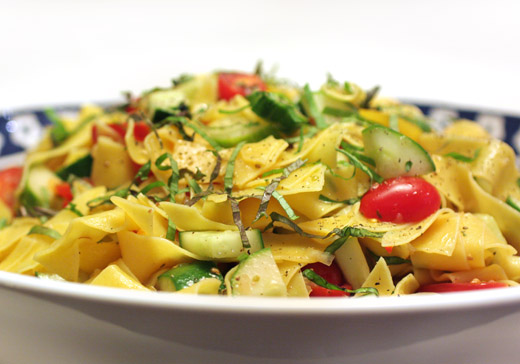
 by Johanne Killeen and George Germon. It’s a book of nothing but pasta recipes, and pasta does make me very happy. I’ve cooked from this book many times, and I know that whatever I pick from its pages is going to be good. Whether it’s pasta with vegetables, tomato sauces, seafood, or baked pasta, the book has never let me down. It had been a while since I spent time with it, so I pulled it off the shelf a couple of weeks ago. I was looking for something light and fresh for summer. The head note to this recipe reads “this is as close to pasta salad as we get,” and that sounded perfect. I made a couple of small changes to the original ingredient list. Instead of using Scotch bonnet pepper sauce, I used some fresh, locally-grown habaneros, and since the oregano in my herb garden hasn’t survived our summer very well, I used fresh basil. To begin, chop large tomatoes or halve cherry tomatoes as I did, and place them in a large bowl. Next, onion was minced and cucumbers were chopped, and both were added to the tomatoes. I seeded and finely chopped two habaneros rather than using pepper sauce. Then, olive oil, red wine vinegar, dried oregano, and salt were added. Fresh oregano was supposed to have been added in addition to the dried, but since my fresh oregano has about two leaves on the plant right now, I added fresh basil instead. The mix of vegetables and herbs with the oil and vinegar was set aside to allow the flavors to mingle and the onion’s sharpness to subside. Meanwhile, the pappardelle was cooked in boiling water and drained. It was then tossed with the vegetables and vinaigrette, more basil was added on top, and dinner was ready.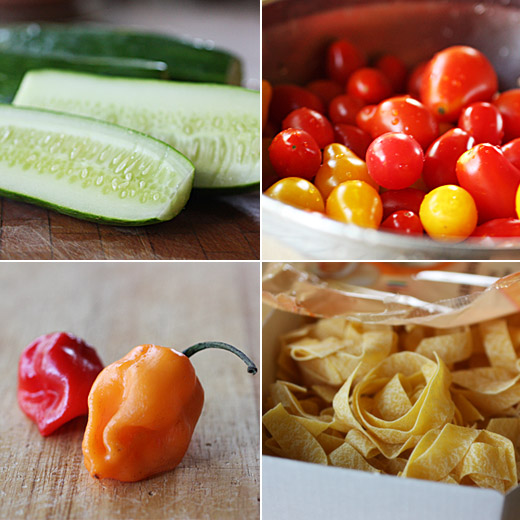

 . In a cold solution of one part salt to ten parts water, salmon fillets are left to soak for about ten minutes. This brief brine seasons the fish and prevents the soluble protein from coagulating into white gunk when it’s cooked. Given the expense of first of the season wild salmon, I don’t mind taking this extra step to ensure the cooked result will be as good as it can be. While the fish sat in the cold brine, the sauce was made in the blender. It was a puree of soy sauce, rice vinegar, mirin, sake, whole-grain mustard, some garlic, and grapeseed oil. Half of the cucumbers were peeled and thinly sliced lengthwise on a benriner, and those became a folded base for the dish. The other half of the cucumbers were julienned along with carrot, daikon, and a red chile. Sliced garlic and shallot were fried until browned, removed from the oil, and then that oil was used to cook the fish. To serve, some soy-mustard dressing was spooned onto the plate, the long pieces of cucumber were folded into a stack, the salmon sat on them, and the julienned vegetables were the crown on top with a garnish of fried shallot, garlic, and black and white sesame seeds.

 falls into that very category. It's been a pleasure to read this book about using locally grown food and the stories about farmers from different parts of the US. The recipes are straightforward and familiar, but they all have an unexpected twist that makes them fresh and new. For instance, beets with goat cheese or feta is a natural combination. But here, cooked beet greens and stems are topped with whipped feta seasoned with Aleppo pepper and mint. There’s also a zucchini bread, but this one has grated carrots and minced candied ginger in it. There are grilled cauliflower steaks with tahini sauce that look great too. The many stunning photos and the little, surprising additions to the recipes kept me turning the pages to see what I’d find next. Throughout the book, there are introductions to farmers from Oregon, Massachusetts, Minnesota, Illinois, and even Austin, Texas, and the stories offer glimpses into what inspires these farmers to do what they do, their challenges, and their successes. I could go on and on, but I will just tell you one more thing about the book. It’s organized by ingredient alphabetically. You can look to the top right or left corner of each page and flip until you find the item you want to prepare. If you just received ten pounds of eggplants from your CSA, flip to the eggplant pages and you’ll get several ideas. Ok, one more thing. There are also recipes for fruits, poultry, eggs, and meat.


 arrived in the mail. Steak! Naturally, my first thought was: what’s in the salad chapter? I received this review copy of Rick Tramonto’s newest book, and it’s devoted to home cooking for casual entertaining. It’s full of ideas for gathering friends around the grill and sharing fun, hearty meals, and it’s also about cooking the things that partner well with steak. So, in addition to steak recipes, you’ll find soups, salads, cedar-plank salmon with mustard and maple, rubs and sauces, grilled chicken with roasted squash salad, bread pudding with gruyere and shitake mushrooms, waffle-battered onion rings with maple-chili sauce, and even desserts. And, while this book is all about entertaining at home, it is clearly from a chef’s perspective with recipes like pan-seared foie gras with peaches and mint, hamachi sashimi with pineapple bubbles (foam), and filet oscar topped with an asparagus and crab salad layered with bread cut in rounds the size of the filet. I like that about this book. I appreciate learning chefs’ techniques as they’re adapted for home cooking. So, of course, Kurt was not deprived of a steak meal, but the first dish that caught my eye was the peanut noodle salad.I made the peanut salad dressing in advance. Peanuts were finely ground in a food processor, and then peanut oil was pulsed into the ground nuts to moisten them. Rice vinegar, soy sauce, chopped ginger, garlic, a chopped red chile, dried chile flakes, ground Szechuan pepper, a little sugar, and some salt were added, and the mixture was processed until smooth. The sauce was transferred to a bowl, and sesame oil and chili oil were added. Interestingly, before adding the dressing to the cooked noodles, it was thinned with hot, Chinese black tea. Thinning the dressing with tea was something I hadn’t seen in other peanut sauce recipes before, but I have to say I’m not sure I noticed the tea flavor among the other ingredients. Chinese egg noodles should have been used for the salad, but I was lazy about making a special trip to buy them and used spaghetti instead. After the cooked pasta was tossed with the dressing, it was topped with sliced cucumber, bell pepper, jalapeno, scallions, and peanuts, sesame seeds, and lime wedges.


With the grilled fish and shrimp with coconut and lime sauce, I wanted to serve a light, crunchy salad on the side. I grabbed a book I hadn’t used for a long time and found just the thing. The Vegetarian Table Thailand was published back in 1997, and it’s full of light and lovely dishes that pack a lot of flavor. I’ve made the salad rolls with a spicy dipping sauce with hoisin and sambal ulek and the Chinese cabbage with peanut sauce. Now that I’ve looked at the book again, I’m reminded that I need to try the vegetarian jungle curry and the eggs in sweet and spicy sauce. From the salads chapter, I could have chosen green papaya salad or roasted eggplant salad, but I went with the cucumber salad with roasted peanut dressing. It was a colorful combination of red bell pepper, green beans, and of course cucumbers.
Cucumber and red bell pepper were cut into matchsticks. Then, green beans and bean sprouts were blanched and added to the raw vegetables along with cilantro leaves, shredded basil leaves, chopped green onions, and chopped roasted peanuts. A quick dressing was made from lime juice, brown sugar, minced garlic, finely chopped red chiles, and more chopped roasted peanuts. As I mixed the dressing, I wondered if there should have been a little light vegetable oil included. With just lime juice as a liquid, I thought it might be too tart. However, the chopped peanuts rounded out the flavor perfectly without any added oil, and the bit of brown sugar took the edge off the lime juice’s acidity.
 I prepared the salad and let it sit in the refrigerator as the rest of the meal was put together, and it emerged cool and crisp with well-distributed flavor. I wished I had some Thai basil to use in this, but the genovese variety worked perfectly fine. The salad was delightfully crunchy with a good variety of tastes and textures. The spice level was mild, but the chile added another dimension. It was a nice surprise to find out how satisfying this salad was given its lightness. With bright, fresh flavors, good crunch, and the nuttiness, it didn’t require anything else to make it great.

We had a great fourth of July holiday weekend. We spent a lot of time outside, we had a lot of fun, but mostly, we ate a lot of food. I had several things in mind that I wanted to try, and I managed to put them together into one big feast of a meal on Sunday night. My original inspiration for the meal came from the cucumbers that were included in our CSA pick up. I love chopped cucumbers simply tossed into a green salad, but these were destined for something more interesting. I’m not sure of the varieties of cucumbers we received, but one was long, skinny, and striped. As soon as I saw it, I started thinking about tzatziki and how I had never made it myself. I flipped to the recipe in the Barefoot Contessa Parties! book, and right there on the preceding page is the tabbouleh recipe. I had also just seen some fantastic-looking watermelon salads on both Kopiaste and Kalofagas, and I decided to put these ideas together along with some pita, feta, hummus, good olives, and grilled kabobs. I wanted to make homemade pita but ran out of time. One of these days, I’ll try making it myself. As long as I’m confessing, I bought the hummus already made as well. There were just too many other fun things to do this weekend, but all the parts came together for a meal that left me wishing I could keep eating for several hours in a row.
Early in the day, I marinated chicken in lemon juice and zest, olive oil, garlic, and oregano. I also started the tzatziki by grating the cucumber and leaving it in a sieve over a bowl in the refrigerator for a few hours. Ina’s recipe suggests that the yogurt also be strained, but I used thick, Greek yogurt and skipped that step. To complete the tzatziki, the strained cucumber was combined with yogurt, sour cream, minced garlic, lemon juice, white wine vinegar, fresh dill, salt, and pepper. The tabbouleh is also a good dish to prepare in advance so the flavors can form a mutually respectful union, and I have actually made the recipe from this book before. First, bulgur wheat was covered with boiling water, and lemon juice, olive oil, and salt were added. That was left for an hour while green onions, fresh mint, parsley, cucumbers, and cherry tomatoes were chopped. After the bulgur had absorbed the water, the other ingredients were incorporated, and it was placed in the refrigerator until ready to be served.
 We had green bell peppers, onions, and yellow squash also from our CSA, so those were included on the kabobs with the chicken. While the kabobs were on the grill, I sauteed sliced haloumi in olive oil for the watermelon salad. I used basil because my mint has succumbed to the heat, and I forgot to save some of the store-bought mint I used in the tabbouleh for this salad. I also completely forgot about the red onion that should have been added to the salad, but it worked out ok. Actually, this simple salad of watermelon chunks, browned haloumi, basil, and olive oil was one of the single most delicious things I’ve eaten lately. I can’t stop talking about it, and I highly suggest everyone give it a try.
 The watermelon salad was definitely the star of the evening, every bite inspired nodding and smiling, but the table was loaded with delicious things. The kabobs were made even better with the tzatziki, the tabbouleh was cool, fresh, and crunchy, and the sharp, sheep feta and mix of olives were tasty accessories on the platter. I’m now wondering why I had never made tzatziki before, but I’ll certainly be making it again. The cucumber, dill-flavored, creamy goodness pairs so well with lemon-marinated chicken. At the end of the meal, we were beyond stuffed, and we were saddened that we’d reached a point at which not one more bite could be taken. Luckily though, with leftovers, we can enjoy it all again.

The thermometer on our back porch shows the current temperature is 107 F. It’s been like this at this time of afternoon for several days now, and because of that, I’ve been in the mood for salads. In fact, every dinner meal I have planned for this week involves a main course salad. The crazy thing, though, is that I’m not opposed to baking or roasting or long simmering in this weather. Once it’s this hot, the added heat from cooking is neither here nor there to me. I’ll happily bake cookies or roast chicken in the summer, but the issue is that what I want to eat in this weather is really just salads. And, ice cream, but more on that later. I issued a warning the other day about how much I’m enjoying Donna Hay’s Off the Shelf, and how I’ll be cooking from it a lot. That’s where I found this noodle salad. The ingredient list is rather short for a salad, but the key element is fried tofu.
I don’t love frying food, and it’s always at least a little messy, but frying tofu might be the messiest of all things to be fried. I started by pressing the block between plates lined with paper towels to remove moisture. Then, after cutting thin pieces, I placed them on paper towels and blotted with more paper towels to remove more moisture. Still, as soon as the tofu pieces hit the hot oil, splattering ensued. I did use a splatter guard, but just in getting the tofu into and out of the pan, there was opportunity for oil to jump its way onto every surface in my kitchen. Before sitting down to dinner, I quickly wiped down the stove and neighboring countertop because it’s so much easier to clean oil before it dries. I was proud of my fast-acting homekeeping action until after dinner when I noticed the floor. So, yes, this dish asks a little of the cook’s patience for frying and cleaning, but I have a solution. If you really don’t want to fry the tofu, you can broil it. I do this all the time to make tofu fries. Coat a baking sheet with spray oil, spread one layer of slivered tofu, then also spray the tops of the tofu with oil, and broil for about three minutes before turning. Continue broiling and turning until the tofu attains the crispness you desire.
 The rest of the salad preparation was as simple as can be. Bean thread noodles were briefly cooked and then tossed with carrots, chopped peanuts, cilantro leaves, and a dressing of sesame oil, soy sauce, and lemon juice. That combination was layered onto sliced cucumber and topped with the tofu. I added some chopped hot chiles just because, and I forgot all about the frying ordeal when I tasted the salad. It’s a great mix of textures and the noodles nicely absorbed the flavor of the dressing. I really liked the delicateness of the bean thread noodles which contrasted with the crunchy vegetables and peanuts. For dinner, the salad was served at room temperature, but for lunch the next day, I found it delightful and possibly even better chilled from the refrigerator. Although, that could just be the heat wave talking.
 Once again, I collected some excellent produce from my CSA share and the farmers’ market yesterday. I have a lot to work with for the next few days and several ideas for experiments. Last night, I invented a cucumber salad as follows:
1 organic cucumber quartered lengthwise and then sliced into 1/4” pieces
1 large, salmonella-free, organic tomato chopped
1/4 organic red onion, thinly sliced
1 organic cubanelle pepper, seeds and ribs removed, chopped
1 t dijon mustard
1 T sherry vinegar
2 T extra virgin olive oil
3 T homegrown, organic basil chiffonade
Brazos Valley Marinated Feta to taste
Salt and pepper to taste
-in a large mixing bowl, whisk together mustard and vinegar, slowly drizzle in oil and whisk until emulsified
-add cucumber, pepper, and tomato to bowl and toss to coat
-plate salad as desired
-top with feta, basil, and season to taste
Something was a little off when we tasted the salad. I really need to taste ingredients before throwing them into a dish! The cucumber had an odd, bitter taste but only on the skin. As we ate the salad, we cut the cucumber skin away on each piece, and then it was fantastic. This morning, I did some searching and found info on bitter cucumbers. The pepper, tomato, and onion were fresh and perfect, and once the skin was removed the cucumber was also great.
The feta is locally made and is not sold in retail outlets as far as I know. As I strolled through the market yesterday evening, I was stopped and offered samples of plain feta, pepper jack, and the marinated feta. It’s all really delicious. The marinated feta worked very well in the salad.


